My Open Source and Web3 Journey: From a First Merged PR to Top Stellar Builder Receipts
1. Introduction: The Silence Before the Commits
If you spend too much time on tech Twitter (X), LinkedIn, or developer TikTok, software engineering can look like a movie montage: minimal glass desk setups, mechanical keyboard ASMR, viral threads on landing rapid Web3 roles, and vanity follower counts.
The reality for builders operating from emerging markets like Nigeria is forged in a much tougher, more disciplined fire.
Here, you don’t have the luxury of taking pristine infrastructure for granted. You engineer defensively. You master local development efficiency, optimize contract storage, and learn to write clean, gas-efficient Rust code and TypeScript that performs flawlessly regardless of network latency.
Building in this environment doesn't hold you back; it strips away complacency. It forces you to become exceptionally resourceful, resilient, and focused strictly on technical substance over social media noise.
At some point, every serious self-taught engineer reaches a crossroads: you realize tutorial apps and vanity metrics won't move the needle on the global stage. What matters is verifiable, battle-tested production code.
In January 2025, I made a conscious decision: I wasn't going to wait around for opportunities to find me. I was going to let open-source proof of work do the talking.
2. The Catalyst: OnlyDust and That First Green Checkmark
When I first discovered OnlyDust—a platform designed to incentivize and onboard developers into open-source Web3 ecosystems—I was intimidated.
Looking through established repositories, with complex monorepos, intricate CI/CD pipelines, and multi-layered architectural patterns, can feel paralyzing. Your internal voice whispers: "What if I make a fool of myself? What if my PR gets rejected with a harsh review?"
I picked up an issue and submitted my first PR.
Then came the review from Sabastine.
He didn't just review the code; he merged it. That single green checkmark on GitHub was a profound turning point.
In open source, maintainers don’t know what school you attended, what passport you carry, or what your background is. They only look at the diff. If the code solves the problem, passes the tests, and follows the architectural conventions, it lands in the main branch.
That first merged PR broke the spell of imposter syndrome. It proved to me that my code was good enough to sit in production alongside international engineers. It gave me the conviction to keep shipping.
3. The Fellowship and the Trap of "Cohort Completion"
With momentum on my side, I didn't stop at one PR. I made open source my daily routine. While others treated it as a casual weekend hobby, I treated it like a full-time engineering apprenticeship.
I picked up difficult bugs, refactored messy components, contributed to documentation, and engaged with project maintainers in community Discords and issue threads.
That consistency didn't go unnoticed: I was selected as an OnlyDust Fellow.
Being an OnlyDust Fellow gave me deeper access to projects, mentorship, and a structured network of builders. But fellowships and grant cohorts have an inherent risk: the completion trap.
I've watched countless talented developers enter a funded program, build enthusiastically while the cohort is active, and the very moment the program ends or the stipend stops, their GitHub contribution graph goes completely blank.
They were participating for the program, not for the craft.
When my fellowship concluded, I made a conscious promise to myself: The fellowship ended; my open-source journey didn't.
4. Continuing Beyond Programs: Drips, GrantFox, and Staying Hungry
True open-source credibility is earned during the quiet periods when there is no leaderboard, no cohort announcement, and no guarantee of a reward.
I immediately redirected my energy into other protocols:
- Drips: Working with streaming payments and dependency-funding protocols forced me to understand advanced smart contract interactions, event listeners, and liquidity distribution logic.
- GrantFox: GrantFox operates much like OnlyDust—a dedicated platform where open-source Web3 projects list issues and bounties, enabling developers to contribute code and earn milestone-based escrows. I had originally contributed to GrantFox when it was a project listed on OnlyDust. When GrantFox launched its own standalone open-source contribution platform and ecosystem, I didn't treat them like a closed chapter. I stayed deeply involved, contributed to their new repositories, and helped build and maintain the software. I wasn't just using contribution platforms; I was actively helping engineer the platforms that other open-source contributors rely on.
This consistency laid the groundwork for my deepest technical chapter yet: the Stellar & Soroban ecosystem.
5. Stepping into Stellar & Soroban: Deep-Diving into Top SCF Repos
Stellar was undergoing a massive technological evolution with Soroban—its Rust-based smart contract platform engineered for high-throughput, predictable fees, and institutional-grade financial rails.
I realized that contributing to the Stellar ecosystem wasn't just about padding a CV; it was an opportunity to master smart contract engineering in Rust, understand contract storage lifecycles, and build decentralized financial infrastructure that directly solves payment friction in emerging markets.
Over the past year, my open-source footprint expanded across several top Stellar Community Fund (SCF) award-winning projects:
Offer Hub
Working on decentralized order-book architectures and decentralized trade matching taught me how to handle concurrency, contract state validation, and gas-efficient storage patterns on Soroban.
Boundless (Bounties)
A platform built to coordinate decentralized task completion, bounty escrow, and payout verification. Contributing here allowed me to bridge front-end Next.js application states with Soroban smart contract events, ensuring users got real-time updates when bounties were funded or fulfilled.
Tansu
Contributing to Tansu meant diving into developer experience, package management, and decentralized artifact distribution. Working at the tooling layer forces you to write code that other developers rely on, which demands zero tolerance for edge-case errors.
KindFi
KindFi is focused on decentralized crowdfunding and social impact finance. Here, the work revolved around milestone-based escrow contracts, ensuring community-funded initiatives disburse funds only when verifiably authorized.
Stellar Security Portal
Security in Web3 is paramount. Contributing to the Stellar Security Portal exposed me to smart contract auditing practices, common Soroban vulnerability vectors (e.g., authorization replay attacks, integer overflows, state bloat), and security incident tracking.
Attempting to Refine Stellar’s Official Documentation
Beyond protocol code, I also attempted to contribute to Stellar's official developer documentation.
While that particular PR didn't end up being merged, the experience itself was an eye-opener. It showed me the sheer level of rigor, clarity, and precision required when documenting developer tools for a global ecosystem.
One of the most valuable things any builder can do is spot friction in developer onboarding. If you battle through an ambiguous tutorial or an undocumented API parameter for four hours, attempting to fix it for the next 10,000 developers is always worth the effort. That engagement gave me an intimate grasp of developer experience, deepened my commitment to onboarding local builders as a Stellar Nigeria Ambassador, and it's an area I'm definitely eager to contribute to again.
6. The Meta Skills: What Open Source Taught Me That Bootcamps Couldn't
A lot of developers think open source is just about writing code in public. In reality, writing code is only 30% of the game. The other 70% is engineering communication, code archaeology, and team coordination.
Here are the three core disciplines open source instilled in me:
1. Reading Code > Writing Code
In school or bootcamps, you start with a blank file (index.ts) and build outward. In production, you almost never start from scratch. Open source taught me how to drop into a 50,000-line codebase I've never seen before, navigate the folder architecture, trace function call stacks, read Git blame logs, and identify the exact 15 lines of code causing a bug without breaking the rest of the application.
2. The Discipline of Asking Precise Questions
In a remote, open-source environment, asking vague questions like:
"Hey, this build is failing on my machine, how do I fix it?"
is the fastest way to get ignored. Maintainers are busy volunteers or core protocol devs with limited bandwidth. Open source taught me the art of the reproducible, structured question:
- Exactly what I was trying to achieve.
- The environment and OS specs.
- The exact command executed.
- The stack trace.
- The 3 things I already tried to debug it and why they failed.
Nine times out of ten, the process of structuring the question precisely helped me solve the bug myself before even hitting send.
3. Asynchronous Empathy for Maintainers
I learned to keep PRs atomic: one bug, one PR. I learned to write descriptive commit messages, attach Loom recordings or test coverage diffs to UI changes, and handle review critiques with zero ego. When you make a maintainer's job easy, your code gets merged.
7. From Contributor to Founder: Engineering BiteHub
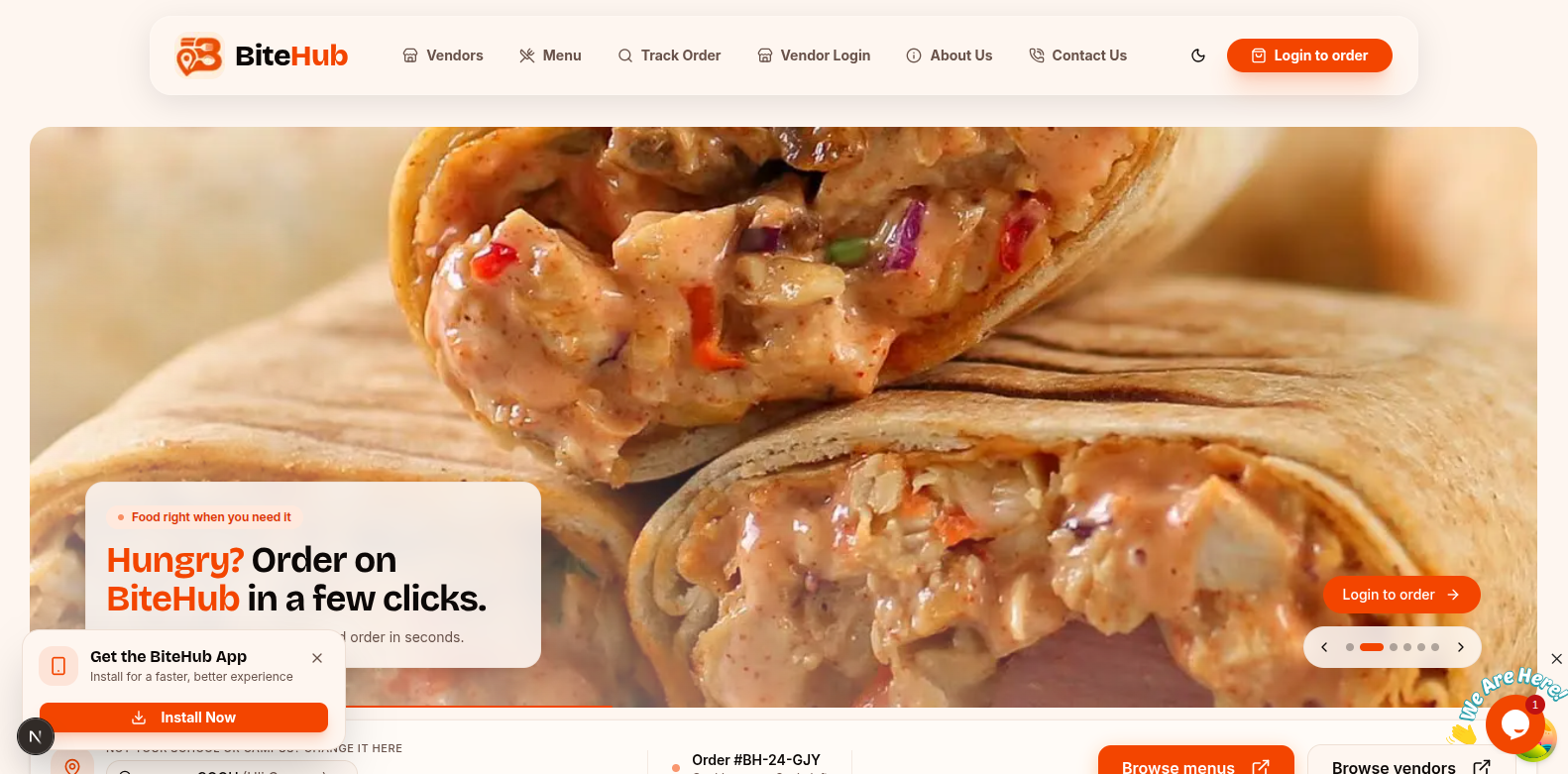
Everything I learned through OnlyDust, Drips, and the Stellar ecosystem culminated in founding BiteHub.
On African university campuses, food ordering is chaotic. Students stand in long queues between lectures, paper receipts get lost, and mobile bank transfer apps frequently suffer 30-minute gateway outages during peak hours.
Because of my open-source background, I didn’t build BiteHub as a speculative whitepaper. I built it defensively:
- Handled edge-case network dropouts on flaky cellular networks.
- Implemented resilient webhook polling and optimistic UI updates for payments.
- Scaled it from an idea into an operational platform that has processed over ₦350,000+ in real food transactions for students and vendors.
And now, we are integrating Stellar and Soroban directly into BiteHub. Sub-cent transaction fees and instant finality mean campus micro-payments can finally operate without being eaten alive by banking gateway surcharges.
Open source gave me the engineering muscle; real African problems gave me the mission.
📖 Want to read the full architectural breakdown?
I wrote an in-depth engineering deep-dive on how we designed BiteHub's resilient architecture, handled real-world infrastructure bottlenecks, and scaled to ₦350K+ in transactions:
👉 Building BiteHub: Engineering a FoodTech Platform for Africa, From a Spring Idea to ₦350K Processed, and Why We're Bringing Stellar Next
8. The Benchmark: What Stellar Light Receipts Taught Me About Imposter Syndrome
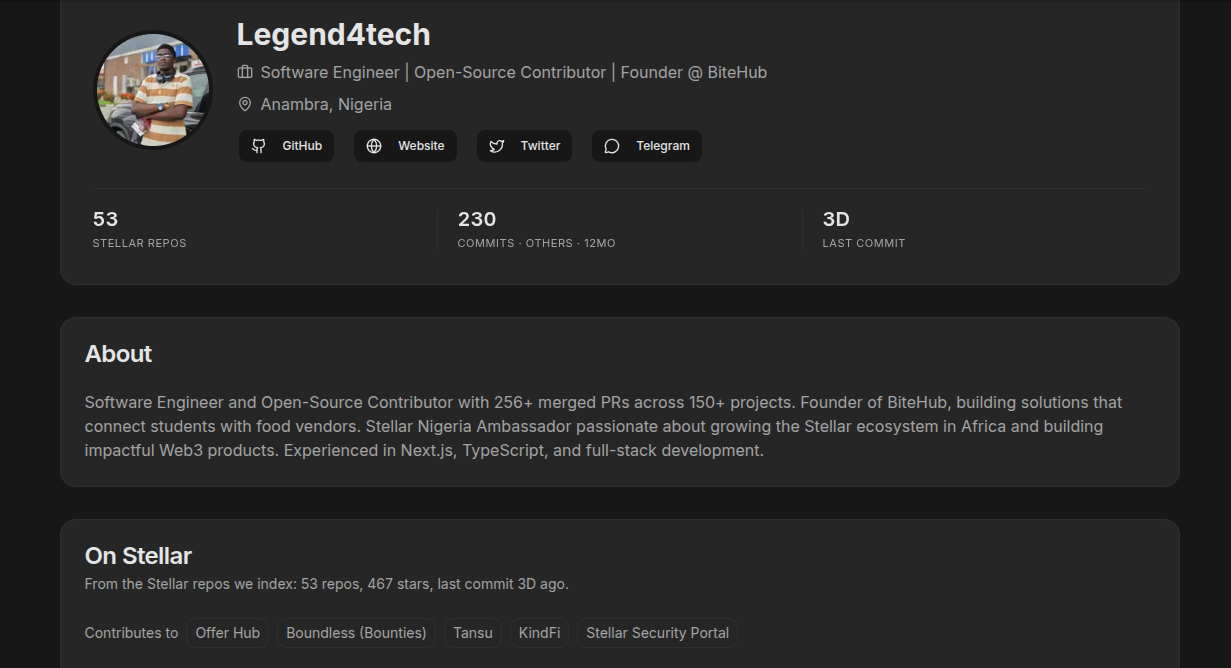
Just recently, I looked at Stellar Light—an ecosystem platform that indexes developer activity directly from Stellar Passport and verified code repositories.
When I filtered the directory for builders in Nigeria, the numbers staring back at me were surreal:
┌─────────────────────────────────────────────────────────────┐
│ STELLAR LIGHT BUILDER INDEX: NIGERIA                        │
├──────────────────────┬─────────────┬───────────┬────────────┤
│ Builder              │ Stellar Repos│ Stars     │ Status     │
├──────────────────────┼─────────────┼───────────┼────────────┤
│ Legend4tech (Dennis) │ 53+ Repos   │ 212 Stars │ Active (3D)│
│ Nearest Contender    │ 26 Repos    │ 107 Stars │ Active (9D)│
└──────────────────────┴─────────────┴───────────┴────────────┘
- #1 in Stellar Repositories: 43+ repositories indexed.
- #1 in Stars Earned: 212+ stars (more than double the next closest builder).
- Core Ecosystem Contributions: Explicitly indexed on Boundless, Tansu, and the Stellar Security Portal.
Seeing that dashboard was a powerful validation.
It's easy to get distracted by developers with massive social media followings and wonder whether quiet, heads-down engineering still counts for anything.
Those receipts reminded me of a timeless truth: Algorithms reward noise, but ecosystems reward output.
The 43 repos and 212 stars weren't manufactured with growth hacks. They were built commit by commit, night by night, through relentless dedication.
9. Closing Thoughts: A Note to Builders in the Trenches
If you are an engineer reading this from Lagos, Nairobi, Accra, or anywhere in the world, grinding quietly to build world-class software:
- Don't wait for permission to start building. Open-source repositories are meritocratic hiring managers that never sleep. Every PR you get merged is an indisputable credential that no one can revoke.
- Never stop when a program ends. Hackathons, fellowships, and grants are launchpads, not destinations. The developers who win over a 5-year timeline are the ones who keep committing when the spotlights are turned off.
- Be grateful for the champions. I will never forget that Sabastine took the time to review and merge my first PR on OnlyDust. When you make it through the door, make sure you leave it open for the next builder behind you.
Keep your head down, eliminate the distractions, and keep pushing code.
The receipts will speak for you.
Thanks for reading! If you're building on Stellar, exploring Soroban, or hacking on open source, I'd love to connect. You can find me on X (formerly Twitter), check out what I'm currently shipping on GitHub, or inspect my on-chain builder activity on Stellar Light.
Let's keep shipping! 🛠️🚀
About the author
- I'm Ajulu Dennis, popularly known as Legend4Tech — a Software Engineer, open-source contributor, and tech entrepreneur passionate about building impactful products, contributing to open-source, and growing tech communities across Africa. I'm the Founder of BiteHub and a Stellar Nigeria Ambassador, driven by a vision to use technology to solve real-world problems and empower the next generation of African builders.
Comments
Join the discussionThis is a great proof-of-work story — the arc from a first merged PR on OnlyDust, reviewed by Sabastine, to 43 Stellar repos and 212 stars is really well told. The part that stuck with me is the fellowship completion trap: finishing a program and then having to keep going without the structure that got you there. And BiteHub processing over ₦350,000 in real vendor payments makes the “ecosystems reward output” line land — it is not just contribution counts, it is something students and vendors actually use. Thanks for sharing the receipts, not just the milestones.
Thank you for taking the time to read ☺️🫡❤️🩹